Lab / R&D · pre-release
Engineering lab / R&D
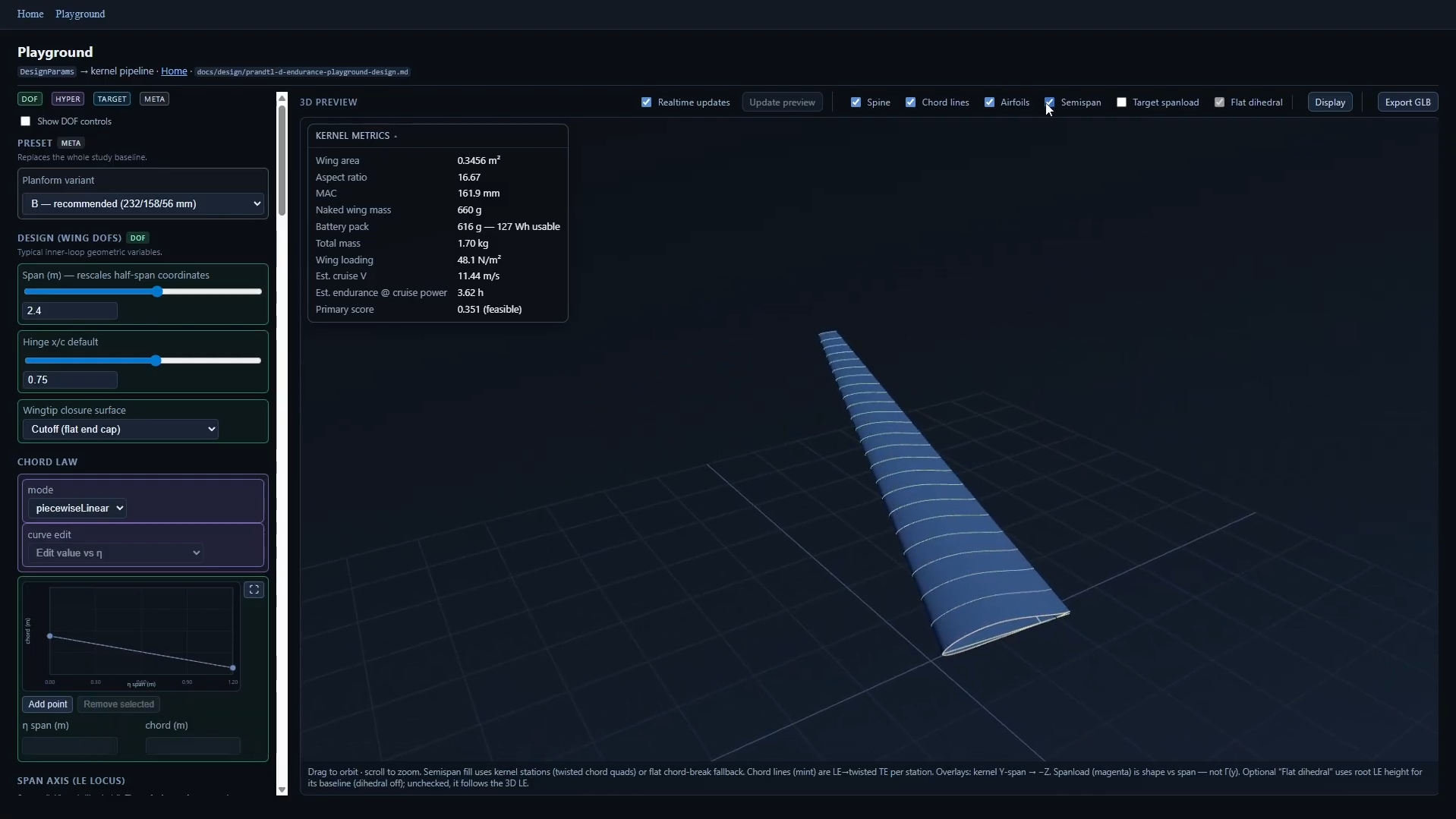
Lab / pre-release (no public demo): Trama Audio Graph (forensic audio, Svelte 5 + WASM/WebGPU) and a parametric wing playground (SvelteKit, Three.js, FastAPI + NeuralFoil for near–real-time design feedback; roadmap: two-phase optimizer with progressive CFD on filtered candidates; optional bell spanload among other spanloads). Evidence of technical range—not a product you can adopt today.
Summary
Infomerx builds in-house, browser-native technical R&D where the hard problem is real-time UX under load: heavy compute, tight feedback loops, and interfaces that stay responsive while graphs, audio, or 3D geometry evolve. Two active threads are collected on this page—both pre-release, described at architecture and intent only, with no stable public URLs linked from the marketing site yet.
Pre-release. No public demo yet. Use the project cards above to jump to each thread; technical depth lives in the sections below.
Technical notes
Trama: Svelte 5 (runes), Web Workers, WebAssembly (AssemblyScript DSP), WebGPU for spectral / FFT-class work, typed worker boundary, Vite + WASM rebuild tooling. Wing playground: SvelteKit 2, Svelte 5, Three.js for interactive geometry; Python FastAPI sidecar with shared request/result envelopes, NeuralFoil on the airfoil path for design-time turnaround, with headroom for a multi-fidelity candidate funnel (surrogate-wide search → high-fidelity CFD on a shortlist), local-first deployment, room for heavier job APIs later.
Why this matters to clients
These threads are not shrink-wrapped products you license today—they are proof of technical range in the same problem classes client teams care about: heavy browser UX, tight feedback loops between analysis and UI, and disciplined separation of concerns so systems stay explainable as they grow. If your procurement question is “can this practice handle demanding interfaces and services without losing the plot,” this page is intentionally specific so you can judge depth without marketing fluff.
Challenge
Forensic restoration work needs both heavy spectral tooling and a way to justify what changed: which stages ran, in what order, and how each contributed to the output. Browser audio hits latency, memory, and GPU vs CPU trade-offs at the same time—while the UI must stay fluid for live waveforms, zoomable spectrograms, and graph editing without fighting the audio thread, and without collapsing everything into one monolithic processor that cannot be inspected or extended.
Technical notes
The product direction is composable nodes (elemental DSP blocks, subgraphs, optional memoisation) rather than one-click black boxes, so experiments can graduate into reusable graphs.
Approach
Separate UI, CPU, and GPU concerns explicitly: Svelte owns interaction and graph editing; workers and WASM own predictable DSP paths; WebGPU owns throughput-sensitive spectral paths where supported. Favour deterministic state and clear boundaries so debugging stays tractable as the graph grows.
Technical notes
Development workflow includes hot-friendly WASM rebuilds, snapshot nodes for stable captures, and room for ML-backed nodes as optional building blocks—still behind the same composition model.
Build focus (Trama)
- Forensic restoration focus — Trama targets damaged, noisy, or compromised recordings where iterative cleanup and spectral repair are part of the workflow.
- Node graph as audit trail — Filters, envelopes, mixers, and spectral tools connect in a visual graph with real-time preview so reconstruction stays traceable and demonstrable.
- Dual compute path — WebGPU-first spectral pipeline with worker + WASM fallback for environments where GPU compute is limited or unavailable.
- Spectral editing affordances — Spectrogram viewing, selection, and masking flows aligned with restoration—not decorative viz.
- Developer ergonomics — Typed workers, WASM build integration, and structure that supports iterative DSP experiments without fork-lifting the whole app.
Technical notes
Project structure keeps the product UI separate from low-level DSP packages with generated worker glue and typed boundaries—so the graph can grow without entangling concerns.
Parametric wing playground (in development)
Designing and iterating parametric wings in the browser means keeping 3D editing, analysis callbacks, and future optimization loops from tripping over each other: the UI must stay interactive while services return structured results the UI can trust and display. NeuralFoil-backed section analysis is chosen in part because it is fast enough for design-time loops—operators get near–real-time reactions as geometry changes—without pretending unfinished wing-level or optimizer paths are production-grade. The intended optimizer path is two-phase: wide exploration on fast surrogates, then progressively more accurate CFD on a filtered set so total simulation time stays under control.
- Interactive geometry — Three.js–backed editing and visualization tied to a single parametric wing model (planform, span axis, twist, airfoil stations).
- Local analysis service — FastAPI service for health checks, batch-style evaluation envelopes, and NeuralFoil-backed airfoil section analysis tuned for real-time design-time feedback (fast surrogate evaluation while the wing is edited); wing-level and optimizer candidate paths are still being wired toward the same contracts.
- Spanload flexibility — Optional Prandtl-style bell spanload steering as a product differentiator; other spanload targets and scoring terms stay on the same core—no forked “bell-only” architecture.
- Optimizer roadmap — Near–real-time NeuralFoil-backed feedback during design; later a two-phase workflow that reserves progressively higher-fidelity CFD for candidates that survive filtering and shortlisting, minimizing time in the slowest solvers.
- Roadmap realism — Mission scoring, ranking, optional browser flight validation, and high-fidelity tiers stay behind documented pipeline stages; marketing copy stays clear of airworthiness or certification claims.
Technical notes
Project structure separates a SvelteKit playground app from server-services (Python package + uvicorn). CORS and tunnel scripts support collaborative local demos; production hardening is explicitly deferred until non-local deployment is in scope. A two-phase optimizer with tiered CFD fidelity naturally points toward job-style endpoints or queues for the slow path while the playground keeps the fast surrogate loop responsive.
Outcomes
Success is measured in engineering leverage for both threads: surfaces where new nodes, rendering strategies, or parametric experiments can be tried without rewriting the shell, with performance and provenance inspectable through the stack. For Trama, that means reconstruction you can walk through—graph in, demonstrable stages out. For the wing playground, it means a coherent path from editable geometry to scored candidates—surrogate feedback first, then a disciplined funnel toward higher-fidelity checks—without overstating what each tier proves today. Public demos and links for either product will be added here when they are stable enough to share.
Public demo
Not published yet. Neither Trama Audio Graph nor the parametric wing playground has a stable public build or hosted URL from this case study today; both remain in-house R&D until a deliberate release.